By clicking “Accept,” you agree to the use of cookies and similar technologies on your device as set forth in our Cookie Policy and our Privacy Policy. Please note that certain cookies are essential for this website to function properly and do not require user consent to be deployed.

The Credential and the Compostela

Planning to walk the Camino de Santiago? Learn about two important documents, the pilgrim’s credential and the Compostela.
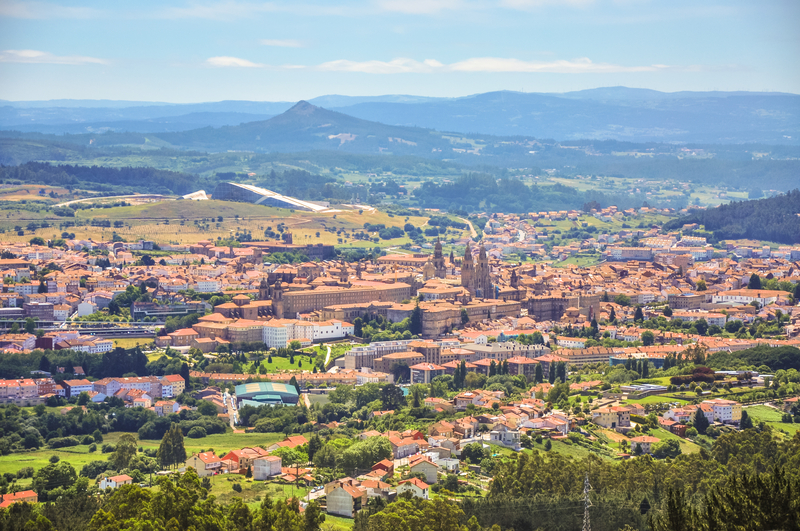
Landscape photo of a town with red roofed buildings amid rolling green hills and mountains
Santiago de Compostela. Photo © Michalrosak/Dreamstime.

A pilgrim’s credential—credencial del peregrino in Spanish and carnet de pélerin in French, also known as your pilgrim passport—is what allows you to stay in albergues along the Camino. Costing €2-3, you can order one online from a pilgrim association before leaving or pick one up at a number of places along the way, including at the pilgrims’ office in Saint-Jean-Pied-de-Port. Getting your pilgrim passport stamped at albergues, churches, and other landmarks is an important part of walking the Camino.

If you want to collect a certificate of completion, the Compostela, you need two stamps per day for a minimum of 100 consecutive kilometers/62 miles walked on any official Camino route in Europe with a minimum of 70 consecutive kilometers (43 miles) needing to be on an official Camino trail in Spain, and pilgrims must be sure also to walk the final stage into Santiago de Compostela, which for the Camino Francés is from O Pedrouzo (Km 20) to Santiago. Those on bikes have the same rules, except that they must cover a total of 200 consecutive kilometers/124 miles. Be sure to visit the official website (www. oficinadelperegrino.com) for details and possible changes in these newly implemented rules.

When you arrive in Santiago de Compostela, take your credential to the pilgrim reception office to receive your Compostela, a jubilant moment!

Planning your trip?

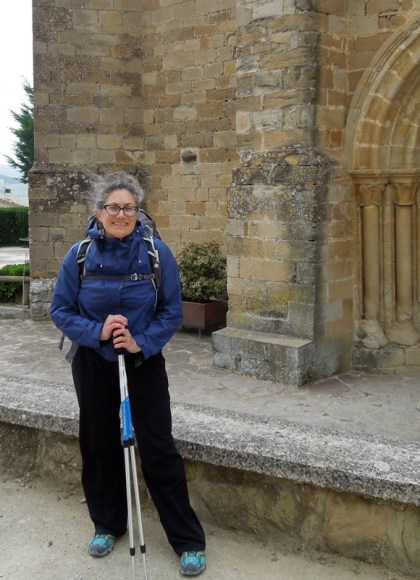
woman standing with hiking gear in front of an old buildling

Beebe Bahrami

About the Author

For over three decades Colorado native, writer, anthropologist, and pilgrim Beebe Bahrami has explored, visited, researched, written about, and lived on numerous routes of the Camino de Santiago in France, Spain, and Portugal, logging well over 10,000 miles, and counting. As a researcher and writer, she discovered long ago that exploring a place at the pace of feet was one of the best tools for uncovering the deeper stories therein, slowing down to talk to locals working the land, to climb to an archaeological site just around the bend, to witness timid wildlife, to sit and listen to villagers share life stories, to discover a remote chapel carved with local extra-religious folkloric images, and to fold into the local cadences of life and land. She has survived pigeon, boar, and rabbit hunting season in the Pyrenees, detoured with sheepherders in Rioja, attended sung prayer for a week with monks in León, tracked down petroglyphs, dolmens, and Iron Age castro sites from Navarra to Galicia, and throughout explored the Caminos deepest layers, from prehistory (including Neandertals!) to the Middle Ages to the present.
 
Many of Beebe’s books, article, and essays center on the Camino de Santiago and the legacy, cultures, and lands through which it threads, such as her literary travel memoirs, The Way of the Wild Goose, Café Oc, and Café Neandertal, and this comprehensive guidebook, Moon Camino de Santiago. Her writing also appears in BBC Travel, Wine Enthusiast, Archaeology, the Pennsylvania Gazette, Perceptive Travel, Michelin Green Guides, National Geographic books, and The Bark, among other publications. Visit http://www.beebebahrami.weebly.com to learn more.
 

Learn more about this author

Pin It for Later

Image of stamped notebook and image of red-roofed town with text Camino de Santiago: The Credential & the Compostela