Camino de Santiago History: Who Was Saint James?
From the Bible, we know that Saint James was one of Jesus’s twelve disciples, son of Zebedee and Salome. James the Greater, as he was known, was one of the three in Jesus’s innermost circle, along with his brother John and with Peter, and was present at the most significant moments of Jesus’s ministry. James was also the first of Jesus’s apostles to be martyred, by beheading, in the Holy Land in 44 CE.
No historical source connects James to Spain or Iberia, where he became known as Santiago. This connection draws from legends that began to circulate several hundred years after his death. According to these legends, James came to Iberia around 40 CE to evangelize but only attracted a handful of followers. At his lowest moments, Mother Mary, who was still alive and living in the Holy Land, came to him to speak words of encouragement. Once, Mary appeared to James in Muxía, riding a stone boat steered by angels. After she left, she left the stone boat behind, a part of the fabled piedras sagradas (sacred stones) that you will find arrayed on Muxía’s coast, right in front of the church built in Mary’s honor, the Santuario da Virxe da Barca. Another time, Mary appeared to James in Zaragoza, where she arrived riding a jasper pillar through the sky, surrounded by angels. After she returned to the eastern Mediterranean, she left the pillar, which stands today in the center of Zaragoza’s Basilica del Pilar.
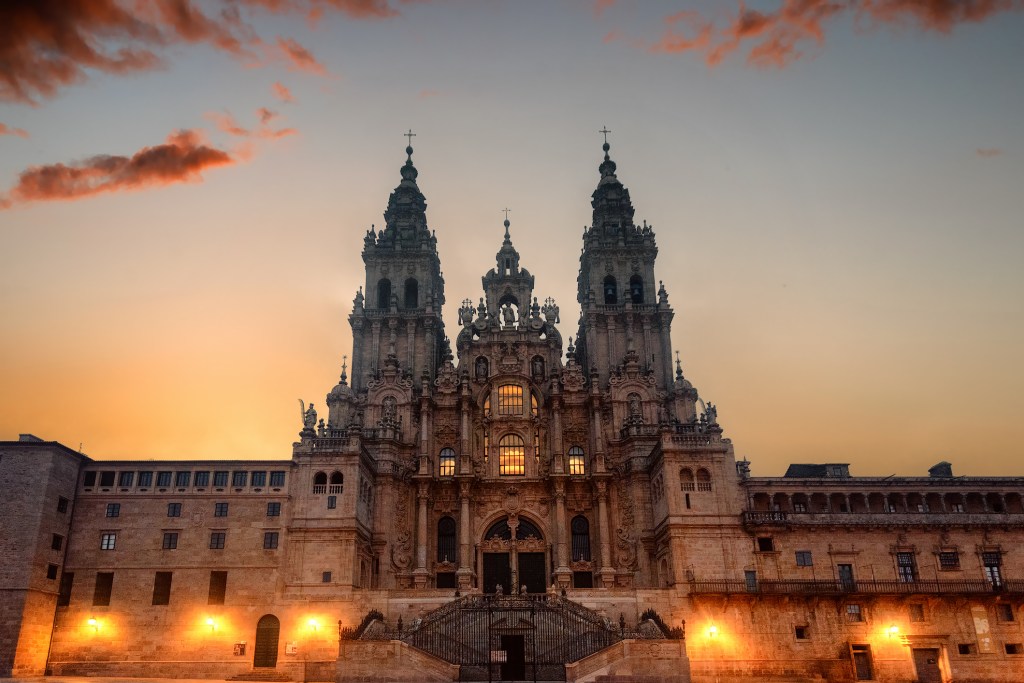
Legends then, especially consolidated in the Translatio, Book 3 of the 12th-century Codex Calixtinus, recounted that after James’s death, his two most devout disciples transferred his body from Palestine to Galicia aboard a mystical stone boat guided by angels. The boat moored in Padrón. After trials and tribulations that they miraculously overcame, they made their way inland to the hill at Santiago de Compostela and buried James. His tomb was forgotten until around 814 CE, when a hermit named Pelayo followed a trail of stars that led him to Saint James’s luminous tomb. Soon after the tomb’s discovery, Alfonso II of Asturias commissioned a chapel to be built over it. By 899, the next king, Alfonso III, ordered a larger church. The Catedral de Santiago de Compostela you see today is the third one, begun in 1075 and finished in 1188. While archaeological excavations under the Catedral de Santiago can’t confirm if one of the Roman-era tombs belonged to Santiago, they did find a 9th-century tomb belonging to the bishop Theodomir, who was with Pelayo at the time of Santiago’s tomb’s discovery.
Pelayo’s star-guided journey was the beginning of what would become the great Christian pilgrimage to Santiago de Compostela.
Planning your Camino de Santiago journey?

Pin It for Later