By clicking “Accept,” you agree to the use of cookies and similar technologies on your device as set forth in our Cookie Policy and our Privacy Policy. Please note that certain cookies are essential for this website to function properly and do not require user consent to be deployed.

Visiting Nova Scotia’s Sable Island

Just under 200 km off Nova Scotia’s eastern coastline is a 40-km-long sliver of sand that was known to generations of seafarers as the “Graveyard of the Atlantic.” Protected today as a national park, Sable Island is inhabited by a herd of about 400 horses that have taken on almost mythical proportions.

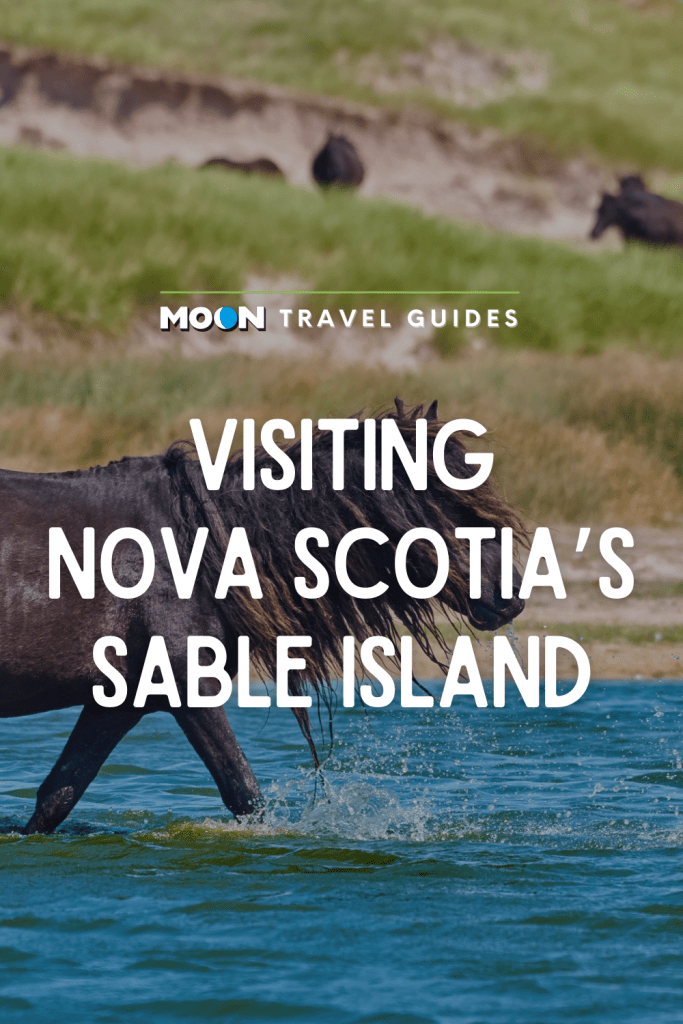
A small black wild horse with an unruly mane walks in a shallow lake with a grassy hill and more black horses in the distance.
A wild horse on Sable Island. Photo © Wirestock/Dreamstime.

The island is made up entirely of sand. The sand is part of a terminal moraine left behind by the receding ice cap at the end of the last ice age 11,000 years ago. Hardy marram grass stabilizes the central part of the island, and seals and birds are also native. The island’s most famous residents are horses; they were introduced in the late 1700s. Some say it was to feed shipwreck victims, while others claim they were aboard ships that came to grief. Today, Sable Island is home to one of the world’s few truly wild horse populations, without feral intruders or human interference. The island has a year-round population of fewer than 20 people—mostly scientists who study the weather and monitor the island’s environment.

Learn more about the island from Parks Canada and the website of the Friends of Sable Island Society.

Getting There

Only about 200 intrepid travelers visit Sable Island each year, most arriving by air charter or private vessel and staying for just the day. The season runs June-November, but June and July are often foggy.

If you’d like to visit, the least expensive option is to book a single seat on a Sable Aviation air charter. Seats cost approximately $2,000 per person, which includes all Parks Canada and landing fees. Check the website in early January for the exact dates that seats will be released for the upcoming summer. Cancellations are occasionally posted on their Facebook page, so it’s also worth checking there.

Kattuk Expeditions offers a guided day trip to the island for $3,350 per person using a helicopter, but again spots are extremely limited. With both these options, you will spend 6-8 hours on the island.


Related Travel Guide
Andrew Hempstead

About the Author

Kayaking around Bowen Island, enjoying a powder day at Whistler Blackcomb, chowing down on pancakes at the Elbow Room, joining the mid-day crowd at Butchart Gardens, and surfing on the west coast – Andrew Hempstead has done all of this and more. He’s out there not because it’s part of compiling a guidebook, but because he loves Vancouver and Victoria. These diverse experiences, coupled with a deep respect for nature and an interest in local history, have been essential in his creation of Moon Victoria & Vancouver Island.

Andrew spends as much time as possible out on the road, and rather than having an itinerary laid out for him by local tourism offices, he travels incognito so he can experience the many and varied delights of Vancouver and Victoria the same way his readers do.

Since the early 1990s, Andrew has authored and updated over 60 guidebooks, contributed to dozens of major magazines, supplied content for online clients like Expedia and KLM, and been employed as a corporate writer for Parks Canada. His photography has appeared in a wide variety of media ranging from international golf magazines to a Ripley’s Believe It or Not! Museum. Andrew has spoken on guidebook writing to national audiences, and he has contributed to a university-level travel writing textbook.

Andrew and his wife Dianne own Summerthought Publishing, a regional publisher of nonfiction books. He and his family live in Banff, Alberta.

Learn more about this author


Pin It for Later

Image of wild horse walking in water with text Visiting Nova Scotia's Sable Island