History of Traditional Hawaiian Foods (and Where to Try Them on the Big Island)
I was first drawn to the Big Island of Hawai‘i sixteen years ago after a lecture by Haunani-Kay Trask, a political scientist and Hawaiian nationalist who came to my university to speak about the rights of native Hawaiians. At the time, I knew Hawaii only as the place in my parents’ ’70s honeymoon photos, or as the tropical vacation getaway in ads and movies. I was surprised to learn about the rich, complicated, and occasionally tumultuous history of the state, beginning with the settlement of the indigenous people of Hawaii, the colonial period, and through to Hawaiian statehood in 1959.
While a vast body of literature exists detailing everything from Captain Cook’s failed exploration of the islands to the recent struggle over Mauna Kea (as it relates to the Hawaiian sovereignty movement), to me, a cultural history of the Big Island can best be learned on a plate.
The Food of Paradise: Exploring Hawaii’s Culinary Heritage by Rachel Lauden is part food history, part cookbook, and it’s my go-to book to better understand how common foods found on the Big Island are deeply embedded in the history of Hawaii.
Traditional Hawaiian Foods and their History
Lau Lau
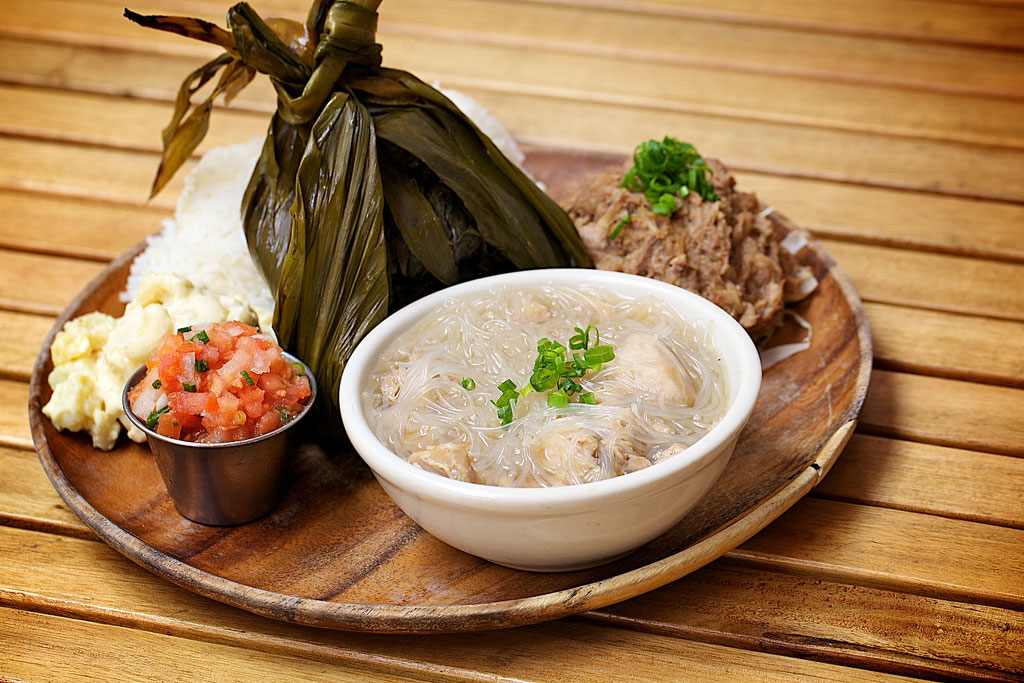
Lau lau, which translates to “leaf, leaf,” is technically is a way of cooking, but it’s also the name of a traditional Native Hawaiian dish prepared by wrapping pork and/or fish in taro leaves and steaming it over an imu–an underground fire. Today the dish is prepared with any protein and steamed in the oven. Oftentimes, lau lau is part of a plate lunch.
Where to get it: Kaaloa’s Super J’s in Captain Cook. Even people who say they don’t like lau lau love it here (I can vouch that it’s delicious!).
The Plate Lunch
The quintessential local food, a plate lunch usually consists of white rice, macaroni salad, and a meat entrée. Found at food trucks, drive-ins, and parking lot pop-up stalls, this carb-filled dish originated in the late 1800s and offered a cheap, filling lunch for plantation workers. The various types of meat entrées reflect the many origins of plantation workers, including places as diverse as China, Japan, the Philippines, and Portuguese colonies.
Where to get it: The Hawaiian Style Cafe in Hilo or Waimea offers both quality and quantity in a nice (air-conditioned) setting. You can also ask for variations such as brown instead of white rice.
Malasada
Malasada, a deep fried pastry that somewhat resembles the Polish paczki donut, was brought to Hawaii in the late 1800s by Portuguese plantation workers from the Madeira and Azores islands. Traditional malasadas just are rolled in sugar, but these days, you’re more likely to taste them stuffed with mango, passionfruit, or even coconut pudding.
Where to get it: The classics are found at Tex Drive-in in Honokaa or Punalu’u Bake Shop in Naalehu.
Spam Musubi
A distant cousin of sushi, spam musubi looks like a long, uncut sushi roll with a thin-cut piece of shoyu-seasoned spam sitting on top of a layer of rice and then wrapped in nori (dry roasted seaweed). Created during World War II when spam was plentiful on the islands, the origins of musubi can be traced back to Japanese internment camps.

Where to get it: You can find variations on spam musubi at any convenience or grocery store. One of my favorites is at the 7-11 in Kurtistown where it’s served hot with an egg on top of the spam layer.
Plan your trip to Hawaii

From golden beaches and towering volcanoes to epic outdoor adventures, a week in paradise awaits with advice from Big Island local Laurie Lyons-Makaimoku.


Celebrate America’s 250th with the ultimate guide to the best of the US! From the Pacific to the Atlantic, through prairies and bayous to snow-capped mountains, find your adventure with Moon USA State by State.